Why Do Paper Reels Break During Printing? 6 Hidden Causes
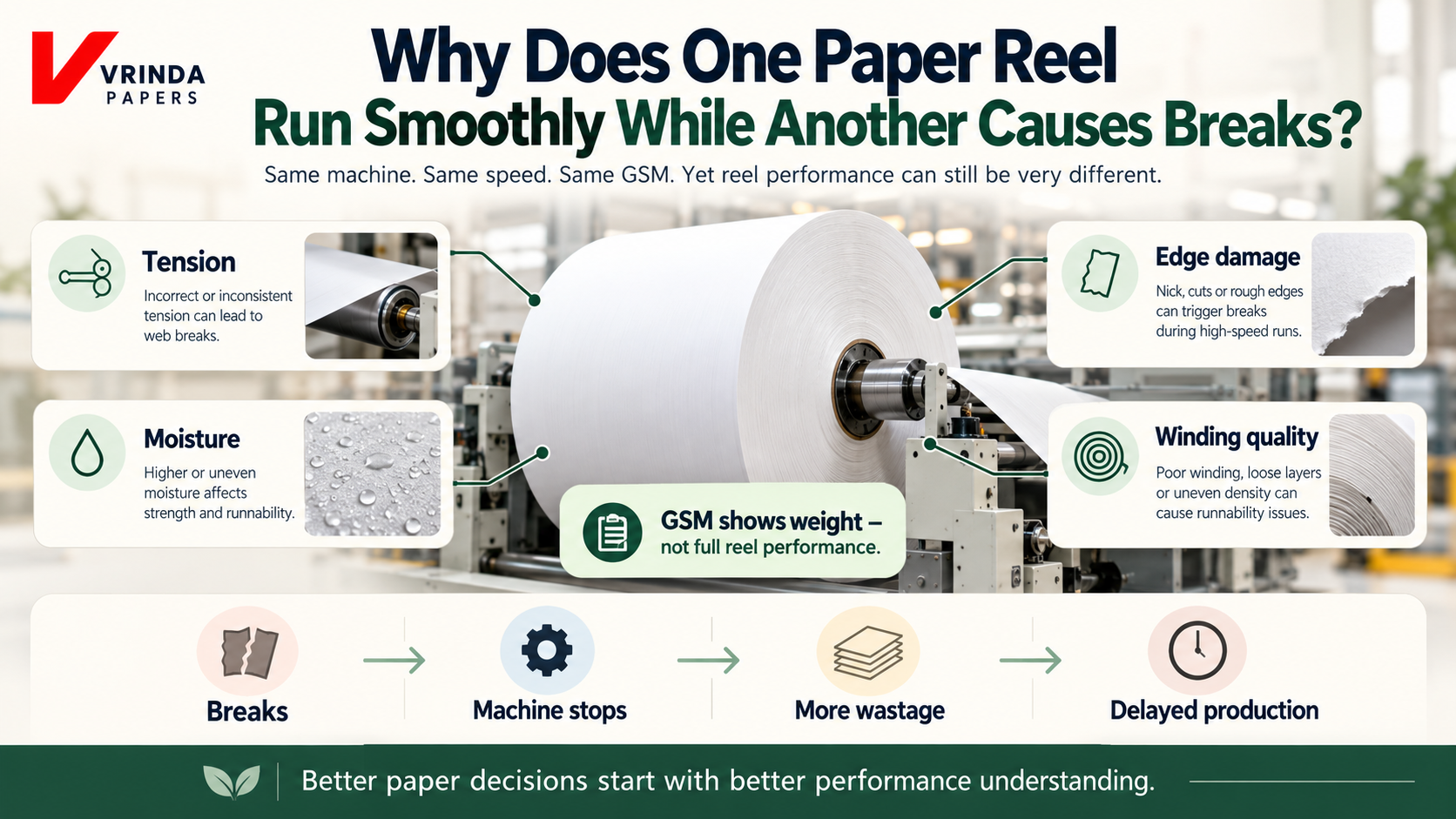
Why Does One Paper Reel Run Smoothly While Another Causes Breaks?
Same Machine. Same Speed. Same Paper GSM. So Why Does One Reel Keep Breaking?
Imagine a printing press running smoothly with one paper reel. The machine maintains its speed, the paper feeds perfectly, and production continues without interruption.
Then the operator loads another reel.
Suddenly, the paper starts breaking. The machine stops, production slows down, and wastage increases.
But here's the surprising part: both reels have the same GSM, width, and paper grade.
So, what makes one reel perform perfectly while another creates problems?
The answer goes beyond paper thickness. Let's Paper Decode the hidden factors behind reel performance.
1. Reel Tension: The Invisible Trouble Inside
A paper reel may look perfectly round and tightly packed, but the tension inside its layers can tell a different story.
During manufacturing and rewinding, paper must be wound with controlled tension.
If the reel is wound too tightly, the paper may experience excessive stress. If it is wound too loosely, layers may shift, wrinkle, or unwind unevenly.
Both conditions can create problems when the reel runs at high speed.
Paper Sense: A reel's appearance cannot always reveal how consistently it has been wound.
2. Moisture: The Hidden Factor That Changes Everything
Paper is hygroscopic, meaning it absorbs and releases moisture depending on the surrounding environment.
When moisture levels change, paper fibres expand or contract.
Uneven moisture distribution can lead to:
- Wavy edges
- Curling
- Wrinkles
- Dimensional changes
- Unstable web tension
Imagine a reel stored near an open warehouse entrance during humid weather. Its outer layers may react differently from the inner layers.
When that reel reaches the printing machine, these differences can affect how smoothly the paper travels.
Paper Logic: Paper doesn't need to look wet to be affected by moisture.
3. Edge Damage: A Small Problem With a Big Impact
Sometimes, the reason behind repeated paper breaks is hiding at the reel's edge.
During transportation, unloading, or storage, a reel can develop small cuts, dents, or tears.
These defects may appear insignificant, but when paper moves under tension, a small damaged area can become the starting point of a larger tear.
At higher machine speeds, even a minor edge defect can interrupt production.
This is why careful reel handling matters just as much as paper quality.
4. Paper Strength: Same GSM Doesn't Mean Same Performance
GSM tells us how much one square metre of paper weighs.
But it does not tell us everything about the paper's strength.
Two reels with identical GSM can behave differently because of variations in:
- Fibre composition and bonding
- Tensile strength
- Tear resistance
- Moisture content
- Paper formation
- Manufacturing conditions
Paper strength can also differ between the machine direction and cross direction.
A reel that performs well under one set of operating conditions may struggle under another.
Paper Fact: GSM measures weight, not the complete mechanical performance of paper.
Also Read: Why Do Printed Colours Change After Drying?
5. Reel Shape and Winding Quality Matter
A well-formed reel should unwind consistently.
However, problems such as uneven winding, telescoping, out-of-round reels, or damaged cores can disturb smooth unwinding.
These issues may create tension fluctuations, vibration, or tracking problems.
The result?
More web breaks, machine stoppages, and production losses.
Even a good-quality paper grade can perform poorly if the reel has been wound, stored, or handled incorrectly.
6. Is the Paper Always Responsible?
Not necessarily.
Sometimes, the reel is blamed when the actual problem lies in the machine.
Incorrect tension settings, poor web alignment, worn rollers, excessive braking force, or unsuitable running conditions can also cause paper breaks.
That is why changing reels without investigating the machine may not solve the problem.
A proper diagnosis should consider both paper characteristics and equipment conditions.
How Can Paper Buyers Reduce Reel-Related Problems?
Before using a reel, check its edges, packaging, core condition, and visible winding defects.
Store reels in suitable conditions, protect them from moisture fluctuations, and allow them to acclimatise when necessary.
If repeated breaks occur, record where the paper tears, the operating speed, reel details, and machine settings.
These observations can help identify whether the problem is related to the reel, the machine, or both.
The Real Cost of a Paper Reel Is More Than Its Price
A cheaper reel may appear economical at the time of purchase.
But if it causes frequent machine stoppages, wasted paper, additional labour, and delayed deliveries, the overall production cost can rise.
At Vrinda Papers Pvt. Ltd., we believe understanding paper performance is an important part of making smarter buying decisions.
Because the right paper isn't just about GSM, size, or price.
It's about how reliably it performs when production begins.
Have you ever experienced repeated paper breaks despite using the same GSM and paper grade? What turned out to be the real cause?