Why Newspaper Feels Different from Magazine Paper | Vrinda Papers
Understanding the Difference Between Newsprint and Magazine Paper
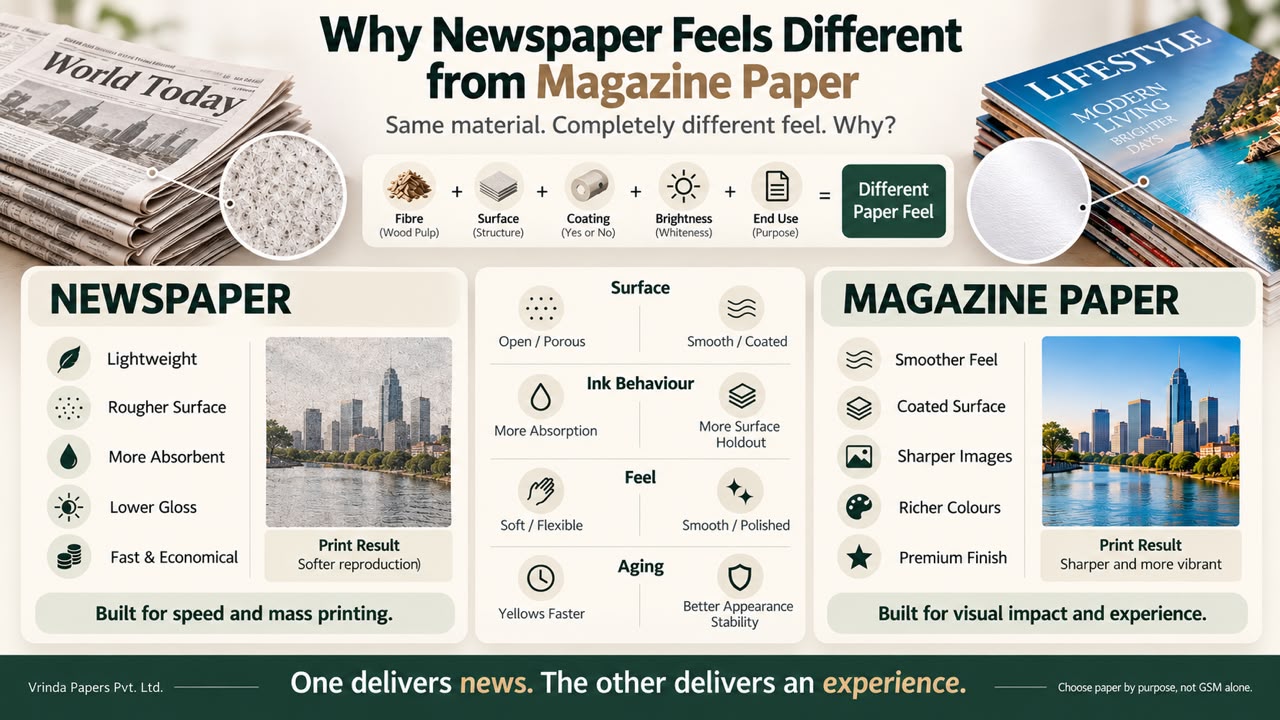
Newspapers and magazines are both made from paper, yet they look, feel and perform very differently. The difference goes far beyond GSM. Fibre composition, surface finish, coating, smoothness, brightness and the intended printing application all influence how each paper behaves. Understanding these characteristics helps printers, publishers and buyers choose the right paper for every job. Pasted markdown
Why Newspaper Feels Different from Magazine Paper
Same Material. Completely Different Feel. Why?
Pick up a newspaper in one hand and a glossy magazine in the other.
You don't need to be a paper expert to notice the difference.
The newspaper feels light, soft, slightly rough and flexible.
The magazine often feels smoother, brighter, heavier and more polished.
Both are paper.
So why do they feel like completely different materials?
The answer goes much deeper than GSM.
It comes down to the Paper Blueprint-the fibres, surface, coating, bulk, brightness and final purpose of the sheet.
Let’s Paper Decode it.
Also Read: Why Does a New Book Smell So Good? The Science Explained
Newspaper Paper Is Built for a Different Job
Newspaper is designed around a simple requirement:
Print huge quantities quickly and economically.
Newsprint is generally lightweight and uncoated. Its surface is relatively open and porous compared with many magazine papers.
That gives it the familiar newspaper feel:
- Lightweight
- Flexible
- Less smooth
- More absorbent
- Lower gloss
- Usually lower brightness than coated magazine stock
It isn't trying to feel luxurious.
Its Paper Logic is speed, readability and economical mass production.
Magazine Paper Has a Different Mission
Now pick up a lifestyle, fashion or product magazine.
Images often look sharper.
Colours can appear richer.
The pages may feel smoother under your fingers.
Why?
Many magazines use coated papers, although not every magazine does.
The coating creates a more controlled Paper Skin, helping provide a smoother printing surface and keeping more ink close to the surface rather than
allowing it to penetrate deeply into the sheet.
The result can be:
• Sharper images.
• Cleaner details.
• Stronger colour reproduction.
• A smoother feel.
• Glossy or matte finishes.
The paper is supporting the visual experience of the magazine.
Why Do Colours Look Different?
This is where the difference becomes easy to see.
On porous, uncoated newsprint, ink penetrates more into the paper structure.
That suits newspaper production, but it does not normally produce the same visual effect as a smooth coated sheet.
On coated magazine paper, ink interaction is more controlled near the surface.
This can make photographs, illustrations and advertising appear cleaner and more detailed.
Same image + Different Paper = Different Visual Result
That's the Finish Code in action.
Why Does Newspaper Feel Rougher?
Surface smoothness is one of the biggest reasons.
Newsprint retains more of the natural character of its fibre structure.
Many magazine papers go through additional surface treatments and may receive coatings that create a smoother finish.
Run your fingers across both.
Your fingertips are effectively reading the Paper Surface.
You can feel a difference that a GSM number alone cannot explain.
Is Magazine Paper Always Heavier?
No.
This is where buyers sometimes get confused.
GSM tells us the weight of one square metre of paper.
It does not completely describe how paper will feel.
Two papers with similar GSM can still differ in:
- Thickness
- Bulk
- Smoothness
- Coating
- Stiffness
- Fibre composition
- Surface finish
So when a magazine page feels more premium, GSM may be only one part of the reason.
Paper Sense: GSM tells you weight. It doesn't tell you the whole Paper Story.
Why Does Newspaper Turn Yellow Faster?
You've probably seen an old newspaper turn yellow or brownish over time.
One important reason is the type of fibre and pulp traditionally used for newsprint.
Newsprint has commonly contained relatively high levels of mechanical pulp, which retains more lignin from wood.
With exposure to light, oxygen and environmental conditions, lignin-containing paper can discolour more noticeably over time.
Many higher-quality publication papers use different pulp compositions and manufacturing approaches designed for better brightness and appearance stability.
That's why an old newspaper and an old premium magazine may age very differently.
Then Why Not Print Newspapers on Magazine Paper?
Because the "best" paper depends on the job.
Imagine printing millions of newspaper pages every day on premium coated magazine stock.
The additional cost and material characteristics would make little sense for a product designed for fast, high-volume distribution and relatively short-term use.
Now imagine a luxury fashion magazine printed entirely on ordinary newsprint.
The photographs, colours, tactile experience and premium positioning would change dramatically.
Neither paper is automatically better.
They are simply built for different Paper Jobs.
That's real Paper Balance.
Paper Hack: Choose Paper by Purpose, Not Appearance Alone
Before selecting paper, ask:
What are we printing?
How important are photographs and colour?
How long should the product last?
What kind of feel do we want?
What printing process will be used?
What is the budget?
These questions tell you much more than asking only:
"What GSM should I buy?"
One Is Made to Deliver News. The Other Is Made to Deliver an Experience.
A newspaper needs to reach thousands or millions of readers efficiently.
A magazine may need to make a photograph look beautiful, an advertisement stand out, or a brand feel premium.
That difference in purpose influences the entire Paper Blueprint:
Fibre + Surface + Coating + Bulk + Brightness + Printing Process + End Use
At "Vrinda Papers", we believe understanding paper begins when you stop looking at it as simply "80 GSM" or "100 GSM."
Because every sheet is designed to do a job.
And once you understand the job, the differences suddenly make sense.
A newspaper and a magazine may both begin with fibre-but their Paper Stories are completely different.