Why Monsoon Season Changes Paper Behaviour | Printing Guide
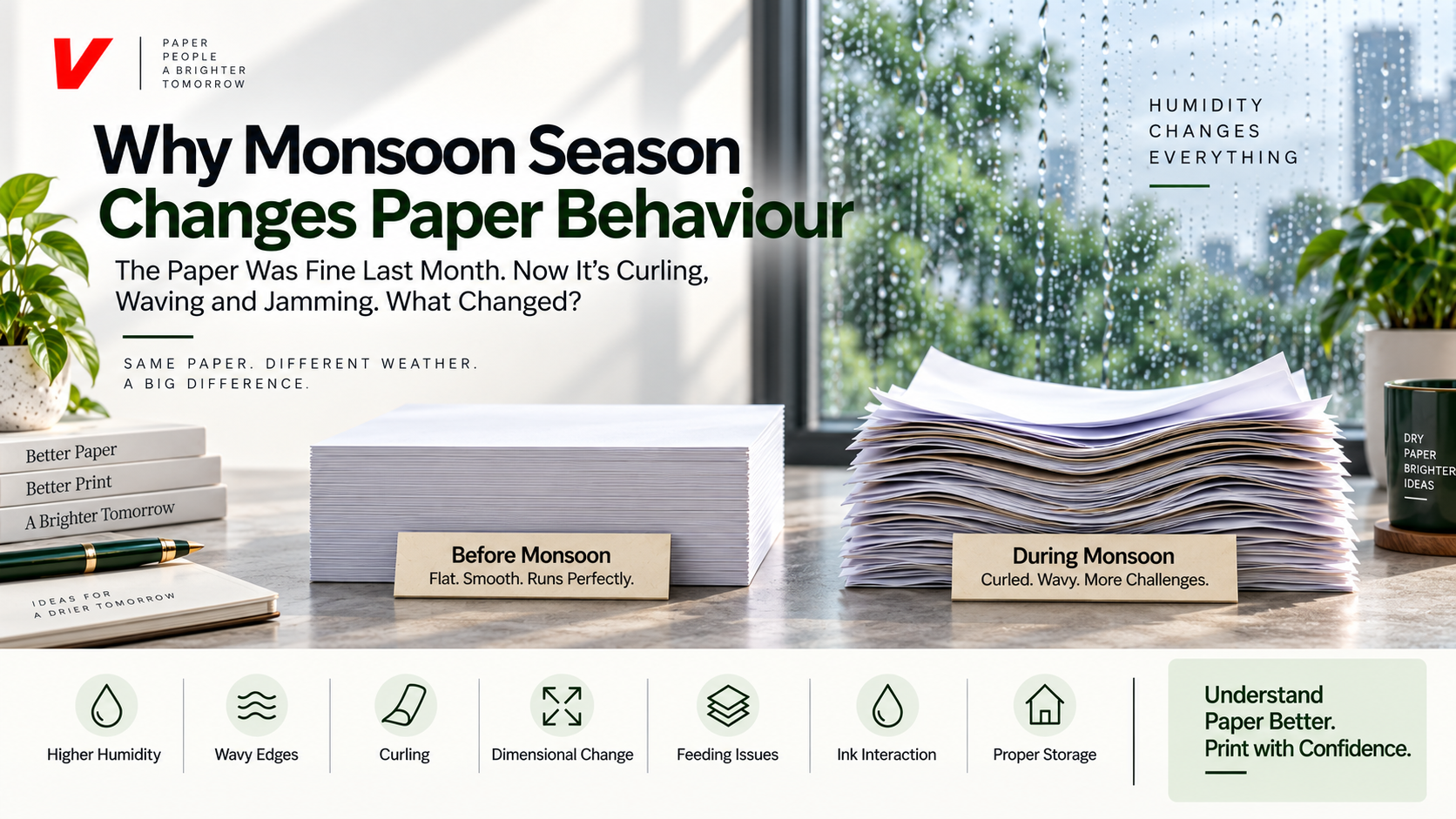
How Humidity Affects Paper Performance During the Monsoon Season
Have you ever noticed that the same paper runs perfectly in winter but starts curling, waving or causing feeding issues during the monsoon? The paper grade, GSM and printing machine may be exactly the same, but changes in humidity can significantly affect how paper behaves. Because paper naturally interacts with moisture in the surrounding air, seasonal weather can influence its flatness, dimensional stability, feeding, registration and overall print performance. Understanding these changes helps printers, converters and buyers reduce waste and maintain consistent production.
Why Monsoon Season Changes Paper Behaviour
The Paper Was Fine Last Month. Now It’s Curling, Waving and Jamming. What Changed?
The paper is the same.
The GSM is the same.
The printing machine is the same.
Even the supplier may be the same.
But as the monsoon arrives, suddenly the paper starts behaving differently.
Sheets may curl. Edges may become wavy. Feeding becomes less smooth. Registration can become difficult.
And a paper that normally runs perfectly may suddenly start creating problems on press.
So what changed?
The weather did.
Paper is not completely unaffected by the air around it. It continuously interacts with its environment-especially humidity and moisture.
And during monsoon season, that interaction becomes much more noticeable.
Let’s Paper Decode what is happening.
Also Read: Why Ink Dries Faster on Some Papers: Complete Printing Guide
Paper Is Hygroscopic - And That Changes Everything
Here is one paper term every buyer, printer, and warehouse team should know:
Hygroscopic
It means paper can absorb moisture from the surrounding air and release moisture back into it as environmental conditions change.
Think of paper as constantly trying to reach a moisture balance with the atmosphere around it.
When humidity rises during monsoon, paper may take up additional moisture.
That can influence its:
• Dimensions
• Flatness
• Stiffness
• Curl
• Surface behaviour
• Feeding
• Registration
• Finishing performance
This is where the monsoon enters the Paper Story.
1. Why Do Paper Edges Become Wavy?
Have you ever opened a stack of paper and noticed that the edges no longer lie perfectly flat?
High humidity may be responsible.
The exposed edges of a stack can respond to moisture faster than the protected centre.
If the edges expand differently from the rest of the sheet, they can begin to look wavy.
This is often referred to as wavy-edge paper.
And once paper loses its flatness, the problem doesn't always stay in the warehouse.
It can travel straight to the printing machine.
Paper Logic:
Uneven moisture → Uneven dimensional change → Wavy sheet → Possible feeding and print issues
2. Why Does Paper Curl During Monsoon?
Curl happens when different areas or sides of a sheet respond differently to moisture, coating, drying, or environmental conditions.
Paper fibres can expand as they take up moisture and contract as they lose it.
If those changes are uneven, the sheet may no longer remain flat.
Curl can create problems during:
Printing → Cutting → Folding → Lamination → Binding
So what appears to be a small Paper Balance problem can affect the complete production flow.
3. Paper Can Actually Change Size
This surprises many people.
Paper dimensions are not absolutely fixed.
As moisture content changes, the fibre network can expand or contract.
The effect is generally more pronounced across the grain than along it.
For a simple job, tiny dimensional changes may go unnoticed.
But in work requiring accurate alignment-such as:
• Multi-colour printing
• Front-and-back registration
• Die-cutting
• Labels
• Packaging
• Precision finishing
even small changes can matter.
That is why moisture control becomes part of Paper Precision.
4. Monsoon Can Affect Paper Feeding
A printing machine needs sheets to separate, feed, travel and register consistently.
But paper affected by humidity may behave differently.
You may notice:
• Multiple-sheet feeding
• Poor sheet separation
• Curling
• Wavy edges
• Inconsistent feeding
• Registration problems
• Reduced press efficiency
The machine may get blamed first.
But sometimes the real problem started before the paper ever reached the feeder.
The press can only run as consistently as the material entering it.
That is the Runability Code.
5. Coated and Uncoated Papers May Respond Differently
Not every paper reacts to humidity in exactly the same way.
Paper construction, fibre composition, coating, sizing, thickness and storage history all influence its behaviour.
An uncoated sheet has a different Paper Skin from a coated sheet.
Likewise, paper and board grades used for books, commercial printing or packaging have different structures and performance requirements.
This is why two papers stored in the same warehouse can show different levels of moisture-related change.
Same weather. Different paper. Different response.
6. Moisture Can Follow Paper Into Printing
Monsoon problems are not limited to curl and wavy edges.
Changes in paper condition can also influence how smoothly the sheet performs during printing and subsequent converting.
Depending on the paper, ink system, press and environmental conditions, this may contribute to changes in:
• Ink-paper interaction
• Drying or setting behaviour
• Dimensional stability
• Registration
• Folding
• Creasing
• Lamination
That creates a larger Paper Chain:
Storage → Paper Condition → Printing → Finishing → Final Product
A problem at the first stage can appear much later in production.
7. The Warehouse Matters More Than You Think
Imagine buying good-quality paper and then storing it:
next to a damp wall, directly on the floor, near an open shutter, or in an area where humidity changes dramatically throughout the day.
Even good paper cannot ignore its surroundings forever.
During humid conditions, proper storage becomes particularly important.
Useful practices include:
• Keep paper in its protective wrapping until needed
• Store it in a clean, dry environment
• Keep stock away from damp walls and floors
• Use pallets or suitable raised storage
• Protect opened stock from prolonged exposure
• Avoid sudden environmental changes where practical
• Allow paper to acclimatise appropriately before demanding print jobs
This is your Paper Shield.
Paper protection doesn't begin at the press.
It begins in storage.
8. Opening the Ream Too Early Can Be a Mistake
Protective wrapping does more than keep paper clean.
It also helps reduce rapid moisture exchange between the paper and surrounding air.
During humid weather, opening more paper than required and leaving it exposed for long periods can allow its condition to change before it reaches production.
A simple Paper Hack:
Open what you need, when you need it.
And protect unused paper again wherever practical.
Small handling habits can prevent larger production problems.
9. Why the Same Paper May Behave Differently in Different Seasons
Suppose a particular paper ran beautifully in January.
You order the same grade again during monsoon.
Suddenly the result feels different.
That does not automatically mean the paper quality has changed.
Compare the complete Paper Blueprint:
Paper + Moisture + Relative Humidity + Temperature + Storage + Pressroom Conditions
Seasonal environmental differences can change how paper behaves.
That is why experienced printers look beyond the specification sheet when troubleshooting.
Paper Hack: Before Blaming the Paper, Check These Things
If paper suddenly starts behaving differently during monsoon, check:
Check Why It Matters
Warehouse Humidity Paper interacts with moisture in surrounding air
Packaging Helps protect paper from rapid environmental changes
Storage Location Damp floors and walls can create problems
Paper Flatness Curl or waves can affect feeding
Grain Direction Moisture-related dimensional change differs by direction
Acclimatisation Sudden environmental changes can affect paper condition
Pressroom Conditions Paper and machine need stable working conditions
Opened Stock Exposed sheets may respond faster to humidity
This is Paper Sense in action.
The Monsoon Doesn't Change the GSM - It Changes How the Paper Behaves
This is the key takeaway.
A 100 GSM paper remains a 100 GSM specification.
But GSM alone does not tell you how that sheet will respond to changing humidity.
The same paper may curl, expand, become wavy, feed differently, or require more careful handling when environmental conditions change.
At Vrinda Papers, we believe good paper performance is not only about selecting the right grade.
It is also about storing, handling and preparing that paper correctly before it reaches the machine.
Because during monsoon, the biggest change may not be visible on the paper specification sheet.
It is in the air around the paper.
And sometimes, controlling that environment is the difference between a smooth print run and a frustrating one.